Showing posts with label Smartphones & Last Tech. Show all posts

Tuesday, May 26, 2015

Samsung Announces Galaxy S6 Edge Iron Man Limited Edition

About a week ago, I wrote an article about how Samsung teased a limited Iron Man edition of the Samsung Galaxy S6 edge through Twitter TWTR -0.22% . Now Samsung has officially announced the Galaxy S6 edge Iron Man Limited Edition as part of a collaboration with the action-packed Marvel’s Avengers: Age of Ultron film.
The metal of the Galaxy S6 edge sports a red color on the front and back with a gold trim around the sides — which are Iron Man’s signature colors. The Galaxy S6 edge Iron Man Limited Edition also has 64GB storage, a matching wireless charger and a 
clear cover. The back of the Galaxy S6 edge Iron Man Limited Edition has Iron Man’s face etched in the center (just like the box it was packaged in). The Galaxy S6 edge Iron Man Limited Edition also has a custom Avengers theme preinstalled. And the wireless charger in the Galaxy S6 edge Iron Man Limited Edition was designed to look like the Arc Reactor.
“We are excited to be able to offer our world-class Galaxy S6 edge smartphone designed especially for Iron Man fans through our continued collaboration with Marvel,” said Samsung’s Executive Vice President of Global Marketing of the IT & Mobile Division Younghee Lee.


Samsung said that the Galaxy S6 edge Iron Man Limited Edition will be available in Korea on Wednesday, May 27, 2015 and it will be rolled out in China and Hong Kong next month. Unfortunately, Samsung did not indicate whether the Galaxy S6 edge Iron Man Limited Edition will be launched in the United States. The Galaxy S6 edge Iron Man Limited Edition will start with a limited run of 1,000 units, which all have special edition packaging. The price of the Galaxy S6 edge Iron Man Limited Edition is not yet known, but I will update this article once I find out more information.

Samsung and Marvel have partnered on multiple projects over the last few years. For example, Samsung gave away four limited edition Avengers cases for the Samsung Galaxy Note 4 in the past. There is also a Battle For The Avengers Towerexperience available for the Samsung Gear VR virtual reality headset. Samsung also offers anAvengers: Age Of Ultron theme for the Galaxy S6, which includes a set of wallpapers, lock screens and icons.
It sounds like the Galaxy S6 edge Iron Man Limited Edition has most of the same hardware 
specifications as the original device. This means it has a 5.1-inch Quad HD display, an Exynos 7420 processor, a 16-megapixel rear camera, a 5-megapixel front-facing camera and 3GB RAM. What makes the Galaxy S6 edge distinguishable from all the other smartphones on the market is its dual edge display. By curving the display on both sides of the device, the Galaxy S6 edge is able to show its users social media notifications, text messages, e-mails and call history even when the phone is face down.
Want to see the Galaxy S6 edge Iron Man Limited Edition getting unboxed? Below is a video that Samsung Mobile uploaded on YouTube of the Galaxy S6 edge Iron Man Limited Edition unboxing:
What are your thoughts about the Galaxy S6 edge Iron Man Limited Edition device? Let us know in the comments section!

Monday, May 25, 2015

Automatic Goes Open Source to Make an App Store for Your Car


You may be familiar with the term “Internet of Things.” This is a phrase coined by Kevin Ashton, a British visionary (per Wikipedia) in 1999, to describe the increasing proliferation of web-ready devices in our daily lives. It covers everything from our phones, watches, and computers to our thermostats, refrigerators, appliances, and even cutlery.
Naturally, somewhere in there are cars. This should come as no surprise, as our vehicles make up a substantial portion of our livelihoods in many regards. On the forfront of automotive connectivity for the common man is a small startup called Automatic, which makes a nifty gadget that can track your car’s health and performance using a dongle that plugs into the car’s OBDII port and communicates with your smartphone with Bluetooth.
The Automatic is a seriously cool little gadget. It will diagnose any engine fault codes, track your fuel economy, and help offer advice on how to improve your driving. It still does all these things, but now it does a whole lot more. With the latest generation (the second), the Automatic now supports two Bluetooth streams at once: One connection is required for the Automatic app, and the second supports any third-party app that uses a new Streaming API that would be used to access your car’s info in real-time, Engadget noted.
The new generation and new API is a part of a new, open-source platform that Automatic is hoping will spur the creation of more apps. “We founded Automatic because we feel that cars weren’t and still aren’t living up to their full potential,” Engadget quoted Automatic’s co-founder and CEO Thejo Kote as saying. “They’re basically computers on wheels. They could be doing so much more.”

The new App Gallery, as the company is calling it, will allow third parties to build a program that will seamlessly mesh with the OBD-based dongle. Though it just launched this past week, there are already over 20 compatible apps, like Harry’s LapTimer, which uses throttle, brake, engine, and other inputs with the phone’s onboard accelerometer, GPS, and camera to create an overlay of driving data, or Nest integration, which will heat or cool your house before you arrive when it notices that you’re heading home.
“What we realized was that the best way to solve all these problems is through a model that all of us are really familiar with already,” Kote said. “An app store, but for your car.”
Of course, this likely raises questions about security and data collection. But Lljuba Milijkovic, who is Automatic’s founding designer and head of marketing, told Engadget that “Automatic’s platform offers greater security because all of the data is encrypted and read-only.”
“With other adapters, the app sends the request, and it puts it into the car’s communication network,” Kote added. “It’s not secure. You don’t want a badly written app to mess with your car. That can never happen with our system.”

5 Types of Businesses That Are Copying the Uber Model

If we’ve learned anything about successful business models in the wake of Uber’s exploding market share, it’s that convenience is king. Despite an onslaught of bad press and the growing pains of creating a company valued between $40-50 billion in just six years, Uber is without a doubt making its mark. On the heels of its great success, other entrepreneurs are lining up to see if they can create their own version of on-demand service that cuts out middle men and makes errand running as simple as opening an app on your smartphone.
By creating the mold for the concierge service industry, Uber has now become synonymous with the idea of at-your-doorstep convenience for completing a multitude of household tasks and daily chores. If you don’t want to walk your dog or finish the list of jobs you have for that day, there’s surely an app that can help you get it finished — or there’s one in the works in the depths of Silicon Valley.
Uber maintains it’s not a car service, it’s a technology company that happens to use its platform to provide people with instant access to a taxi alternative in the cities in which it operates. Whether that’s a company vision plan or just a way to get around transportation regulations in countries like India remains to be seen, but regardless, we’re now at the point where other startups are aiming to be the “Uber of X,” where “X” is any other delivery, concierge, or general errand service.
These types of services fit well into tech hubs like Silicon Valley, where “disruptive innovation” (that upends old systems with new technology) is paramount, The Guardian notes. The quest for disruptive innovation replaced manual labor with the cotton gin, substituted letters with email, and now is likely to completely change the ways people with smartphones — and a penchant for convenience — complete numerous tasks in their daily lives. Here are five industries that are already starting to see an onslaught of apps to help people in their daily lives. They’re not always cheaper than the standard method, but they often save time or at least make life a little simpler. Now, it’s an individual question of whether that’s worth it.
Source: iStock

1. Laundry

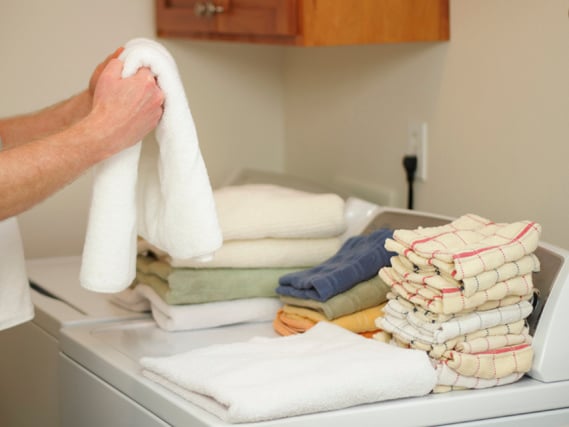
Just as parents sometimes sign their college children up for wash ‘n’ fold services that pick up laundry and return it clean and folded, there’s now numerous apps that ensure you never have to touch a dirty sock again for all of adulthood, if you wish.
FlyCleaners, which operates right now in Brooklyn and Manhattan, will have someone pick up the laundry right from your doorstep, and return it to you within less than 24 hours. (If pickups happen before 11 a.m., it’s ready by 7 a.m. the next day.) Pickup and delivery happens from 6 a.m. until midnight daily, seven days a week. The company also offers dry cleaning services. According to estimated pricing from Manhattan ZIP codes, laundry will cost about $1.25 per pound of clothing, with individual pricing on special items like pressed shirts ($2.50 each) and dress or suit cleaning ($12 each). The company also allows you to customize how you’d like your laundry finished, down to the amount of starch or if you’d like to use bleach for an extra cost.
Washio, perhaps a larger name in the industry because it operates in six major cities (Chicago, Boston, Los Angeles, Oakland, San Francisco, and Washington, D.C.), also offers “on demand” services and delivers laundered clothing within 24 hours of pickup, right from your door. Wash and fold services (mostly for t-shirts or jeans) is about $1.39 per pound, with varying prices for blouses ($4.99), dresses ($8.75), coats ($12.99) and more. Minimum orders are $20, with a surcharge of $3.99 for orders less than $35.
This is one of the cases when convenience will have to be more important than cost, as Geoffrey A. Fowler, who tested several concierge apps for the Wall Street Journal, noted. “Washio charged me $1.60 per pound of laundry plus a delivery fee; I could have done it for a little less by bringing the hamper to a wash and fold, or a lot less by doing it myself,” he wrote. Despite the price it seems to be catching on, as TechCrunch reported in February the company has raised more than $13 million in funding.
Source: Shyp

2. Shipping

For individuals and businesses alike, shipping is one of the great logistical headaches. Now, apps are starting to creep up that eliminate your trips to the post office or nearby FedEx, UPS, or DHL site. Shipster is one of them, and basically requires people to take a picture of the item they’d like to send (from a card to a desk chair, and more), and their address plus that of the destination. A ‘Shipster’ arrives at your doorstep and takes the item, packaging it and sending it on its way to anywhere around the world. The app is live in Brooklyn and Manhattan with apparent plans to expand soon, though CEO Christian Vizcaino didn’t mention where in his interview with AlleyWatch in September 2014.
Another similar app is Shyp, which operates in New York City, San Francisco, Miami, and is in beta testing in Los Angeles. Fowler, of the Journal, said that the service picked up a package and shipped it for a fee of $5, for a total cost of about $48 for the shipment. The company negotiates bulk rates with carriers like UPS and FedEx, and the total was about what Fowler would have paid if he had gone to a shipping center and packaged it himself, he said. Both services are rated highly in Apple’s App store at 4.5 stars, though Shyp has had much more user feedback (a total of almost 250 reviews compared to Shipster’s 37).
Source: Luxe

3. Valet services

Finding a decent parking spot can be a pain in any city, a problem if you’d like to maintain the freedom of having your own car. Of all the apps Fowler used over the course of a week, the GPS-powered valet service Luxe was his favorite. The company operates in San Francisco, Los Angeles, and Chicago, and has plans to expand to Seattle and Boston. The service works much like a normal valet, with a few added perks. You let the company know via its app where you’re going to be. A valet picks up your car (and will even wash it or fuel it up for you, if you’d like), and then can return it to any spot within its service area — even if it wasn’t originally where you dropped off the car.
Fowler called the company a “marvel” of logistics, as the app tracks where you’re going so the attendant meets you at your destination at exactly the right time. (Fowler added that each of the attendants are fully vetted, trained, and insured.) The service for the entire day cost Fowler just $15 plus $3 in tip money, much less than the $35 he would normally pay for parking in his own building. That’s largely because the company negotiates better rates with underused parking garages around the city, Fowler explained. The only downside to this, he said, was that the company closes by 6 p.m. on Sundays — other days it’s open until 11 p.m. or midnight.
Source: Thinkstock

4. Health

True to the plot lines of Royal Pains, the idea of concierge medicine is one that immediately evokes images of living in the Hamptons with too much money to bother waiting in an overcrowded waiting room to see a doctor. The cost alone to get personalized care from a doctor used to put the idea of concierge medicine out of reach for most people. But with the rise of some medical apps, that’s not the case as much anymore. One Medical Group has an app that allows people to make doctor’s appointments and request prescription refills at the touch of a button, while also gaining email access to your doctor. One Medical operates in San Francisco, New York City, Washington, D.C., Boston, Chicago, Los Angeles, and Phoenix, and works with most insurance providers. The San Francisco Business Times reports that the annual fee to use the service in the Bay Area is $149, and is an employee benefit offered to those working for Twitter, Airbnb, Pinterest, Adobe, and more.
Another app that is reinstating doctors’ house calls is Heal, which is operating in Los Angeles and San Francisco. The company claims it will have a well-trained doctor to your doorstep in less than an hour from placing a request on the app, with a flat $99 fee per visit. The staff vary in their specialties from pediatric medicine to cardiology — the doctor that arrived on Fowler’s doorstep during his weeklong app tests studied at Stanford. The fee truly is $99, Fowler attested, and didn’t accept his insurance. It might not be Hamptons level, but there’s still definitely a cost for the convenience.

Source: Munchery.com

5. Meal preparation

Nothing gives you a range of possible apps to use quite like the food and meal preparation industry. AmazonFresh and others deliver foodstuffs to your door, sometimes without a delivery fee if orders reach a certain value. Instacart, which operates in about 15 national locations including San
Francisco, Philadelphia, Boston, and Chicago, is gaining lots of attention not only for its to-your-door convenience, but also for the quality of foods (especially produce) shoppers select for clients. “Our service is available to anyone who can afford our $3.99 delivery fee,” Apoorva Mehta, CEO of Instacart, told the San Francisco Business Times. The service shops at a variety of stores including Costco, Safeway, and Whole Foods, they reported, and tried to match in-store product prices, though there’s sometimes a mark-up on items like gallons of milk. The company has raised $220 million at a $2 billion valuation, the publication reported in January.
But for those who want more than the raw ingredients delivered to their doorstep, there’s a growing number of apps that will deliver hot meals for your dinner. Munchery operates in San Francisco, New York, and Seattle, and offers custom dishes from on-staff chefs including peppercorn crusted steak ($11.95 per plate), vegetarian pasta with mushrooms, peppers, and fresh pesto ($8.95), and gremolata baked salmon ($11.50). The company also contributes to local food banks for every meal purchased. Delivery is free for every meal with a $39 annual charge, the Business Times reports. Munchery is one of dozens now in the meal delivery game — others also in contention are Postmates, SpoonRocket, Caviar, and Blue Apron.

These Are the Most Popular Web Browsers Today

You’ve probably tried several web browsers and have determined which one is your favorite. But have you ever wondered which are the most popular web browsers among Internet users? You might be surprised to learn that Microsoft’s infamous Internet Explorer is still the most popular option, but Google’s Chrome is gaining users quickly.
VentureBeat’s Emil Protalinski reports that April saw the naming of Microsoft Edge, the release of Chrome 42, and the first full month of Firefox 37 availability. Between March and April, Google Chrome finally passed the 25% user share milestone, according to Net Applications, which uses data captured from 160 million unique visitors to about 40,000 websites. As Computer World’s Gregg Keizer notes, user share acts as an estimate of the percentage of the world’s Internet users who ran a specific web browser during a given month.
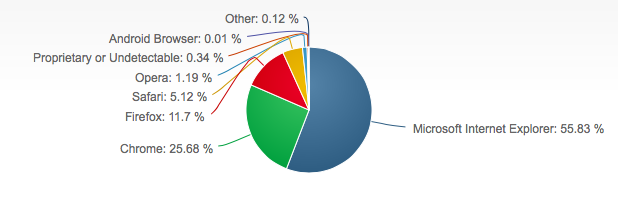
The latest figures from Net Applications show that Internet Explorer’s market share fell by 0.71 points to 55.83%, while Chrome’s market share rose 0.69 points to 25.68%. Firefox’s market share fell 0.19 points to 11.70%. Safari’s market share rose 0.12 points to 5.12%, and Opera’s market share rose 0.05 points to 0.48%.
Source: Netmarketshare.com
Protalinski reports that while Internet Explorer’s market share fell overall, there was still good news for Microsoft’s browser. The latest version of Internet Explorer, IE11, grew 0.82 percentage points while IE10 and IE9 slipped 0.17 and 0.21 percentage points, and IE8 fell 1.26 percentage points. Among even older versions of Internet Explorer, IE7 gained just 0.03 points to reach 0.37%, and IE6 fell 0.06 points to 0.92%. In October, IE11 passed IE8 to become the world’s most popular browser, and the gap between them continues to widen.
The trend toward adoption of the latest versions of Internet Explorer was catalyzed by the loss of significant market share by Windows XP, whose users can’t upgrade past IE8. (As of January 2016, Microsoft will support IE9 only on Windows Vista and Windows Server 2008, IE10 only on Windows Server 2012, and only IE11 on Windows 7, Windows 8.1, Windows Server 2008 R2, Windows Server 2012 R2, and Windows 10.) Protalinski notes that IE11 can now grow “unchallenged” until Microsoft’s new browser, Edge, arrives.
As is typical with Google Chrome, older versions of the browser continued to lose market share as Chrome 42 gained market share. Chrome 41 slipped 1.80%, Chrome 40 fell  by 5.56 percentage points, and even older versions lost market share as users adopted the newest version.
Meanwhile, Mozilla’s Firefox has continued to hit new lows for months, but its built-in upgrade system consistently sees users upgrading to newest versions of the browser. Firefox 37 gained 6.12 percentage points to hit 6.45%, while Firefox 36 dropped 5.24 percentage points and Firefox 35 fell by 1.21 percentage points.
Keizer reports that Mozilla’s Firefox reached the 25% user share milestone that Chrome just achieved in November 2009, when its user share was just over 25%. Firefox held onto that user share for a month, dipped under it, and then regained it again in March and April 2010, when it peaked at 25.1%. After that, Keizer notes, Firefox went into “more or less permanent decline.”
Mozilla’s position in the browser marketplace is growing increasingly tenuous, and in the last 10 months, Firefox has lost more than 5 percentage points. The biggest benefactor of Firefox’s losses has been Chrome, which has gained 7.8 percentage points in the past year, representing an increase of 47%.
As Business Cheat Sheet reported recently, Civic Science surveyed 1,287 adults in April to figure out what consumers’ preferences in Internet browsers say about them. Among the users that Civic Science surveyed, Google Chrome was the top web browser choice, followed by Internet Explorer, with 37% reporting that Google Chrome is their browser of choice, 29% choosing Internet Explorer, 21% picking Firefox, 10% favoring Safari, and 4% reporting that their favorite Internet browser was one other than the choices offered.
The report found that Google Chrome is the top choice of millennials who keep up with the latest trends and new products, while Internet Explorer is the browser of choice among older individuals, who have grandchildren and a high rate of home ownership.
The users who prefer Mozilla’s Firefox fall somewhere in between the characteristics of Chrome and Internet Explorer fans, and based on the smaller amounts of data gathered on those who prefer Safari, they tend to align more closely with Chrome users and skew younger and slightly more female.

Why Your Password is Hackerbait (Infographic)

Another day, another warning of potential password pitfalls. Is it just us or do the days of handwritten letters and carrier pigeons seem to be increasingly appealing?
We recently wrote about the fact that people are still using terrible passwords. The passwords themselves are just the beginning. A new infographic compiled by password-management firm Meldium shows some interesting (read: frightening) statistics on how our online behavior is leaving us vulnerable to cyberthieves.
Did you know, for instance, that 90 percent of employee passwords can be cracked in six hours? That’s less than a full work day! Moreover, nearly two-thirds of people use the same password for their many different accounts. Imagine if whomever you shared your Seamless account password with also had your online banking password. Not a pleasant thought.
The infographic below offers a look at the common ways of keeping track of various passwords, and how often people forget the magic word or phrase for a site.
Click to Enlarge
Why Your Password is Hackerbait (Infographic)

Top 10 Smartphones You Can Buy In 2015


The smartphone market is very healthy at the moment. Whilst there’s no one, single, perfect smartphone, some recent releases have come close. But which one is best for you?
Fortunately, I have some answers. Having fumbled around with almost every major smartphone over the last 12 months, I’ve picked my top 10 which is based on performance, quality, features and all-round awesomeness. I’ve also added a few special mentions at the bottom which reflect some of best value for money handsets that don’t quite cut it against the best.
If you want more information, be sure to click through to the Forbes review for each device. Hopefully the summary will help you finally decide which company you should hand a giant wad of cash over to.
8-10.-Samsung-Galaxy-Note-4
10. Samsung Galaxy Note 4
Price: From $729
Display: 5.7-inch quad-HD Super AMOLED
Battery size: 3220mAh
Camera: 16MP (rear) 3.7MP (front)
Platform: Android with TouchWiz
Features: microSD, removable rear cover and replaceable battery, stylus pen included, Samsung productivity apps, long battery life and one of the best Android cameras on the market.
Before the Galaxy S6 and S6 Edge were released, the Note was a strong contender for best Android handset. With that said, it’s still a very good smartphone. The camera is still among the best, the super AMOLED display is unmatched (except by the S6) and the addition of a stylus pen is a nice touch.
The Note 4 represents the best that Samsung can offer. The radical redesign of the S6 and S6 Edge will divide some, particularly because of the omission of popular stalwarts like a removable battery and microSD slot.
The Note 4 has both, not to mention a Super AMOLED QHD display and the same 16MP camera as the S6 and S6 Edge (albeit without the f1.9 lens). Before the S6 and S6 Edge were released, the Note 4 was the best Android camera hands-down. It’s now second best, but still very capable.
The phablet also includes a stylus pen that can recognise hand-written text and provide more dexterity when editing pictures, or anything else that requires intricacy.
It’s a powerful all-rounder that will give you hours of battery life and offer plenty of functionality. It does, however, also mean you have to deal with Samsung’s old, garish, TouchWiz. As well as Samsung’s policy of pre-loading smartphones with a shocking amount of bloatware that makes your app drawer look crowded before you’ve downloaded your first app.
7-9.-LG-G3
9. LG G3
Price: From $500
Display: 5.5-inch quad-HD IPS
Battery size: 3000mAh
Camera: 13MP (rear) 2.1MP (front)
Platform: Android with LG overlay
Features: laser auto-focus, slick user-interface, removable rear cover and replaceable battery
The LG G3’s quad-HD display and premium design make it stand out against the competition. It also has one of the slickest interfaces compared to most other Android devices.
LG’s G3 set standards early last year, and it’s still one the top handsets about. The South Korean company is gearing up to launch its successor in a few weeks, but the LG G3 still has a lot to offer.
The QHD display is one of the G3’s main draws (it was one of the first smartphones to boast this display technology), which looks sharp and crisp. There’s also a hugely improved user interface that dovetails nicely with the quality of the display.
The premium design and top-end display technology is complemented by the fact that it’s one of the cheapest smartphones on the list, so you’ll definitely get value for money. Throw in a laser-based auto-focus – and striking design – and the LG G3 resolutely stands toe-to-toe with the best.
Unfortunately that much power in the display also means that battery life if severely affected, with the G3 struggling to last an entire day with medium use. There’s also the strangely placed buttons on the back of the device, which are awkward to reach with such a large device.
6-8.-Motorola-Droid-Turbo
8. Motorola Droid Turbo
Price: From $600 (Verizon only)
Display: 5.2-inch Super AMOLED quad-HD
Battery size: 3900mAh with quick charging
Camera: 21MP (rear) 2MP (front)
Platform: Android
Features: stock Android, active display, large battery, wireless charging
The Motorola Droid Turbo is one of the most powerful Android smartphones on the market with its impressive list of specifications.
Motorola’s Droid Turbo was quietly one of the best android handsets of 2014. It sports a list of specifications that reads like an all-star cast of a blockbuster movie.
Here goes: a 5.2-inch Super AMOLED quad-HD display, 21MP camera, whopping 3900mAh battery, quick charge (60% in 30 minutes), 3GB of RAM and Motorola’s active display. It also supports wireless charging and runs on stock Android. It’s a true all-rounder.
The slick design and thin frame is deceptive given how large the battery is – not to mention everything else that’s packed into the Droid Turbo. Its 5.2-inch display feels just right, and the plastic casing means it’s not as slippery as all-metal handsets. The only downside – and it’s a big one – is that it’s exclusively available on Verizon, which means it comes pre-loaded with a LOT of Verizon-related bloatware.
5-7.-Sony-Xperia-Z3
7. Sony Xperia Z3
Price: From $529
Display: 5.2-inch, 1080p IPS
Battery size: 3100mAh
Camera: 20.7MP (rear) 2.2MP (front)
Platform: Android with Sony overlay
Features: waterproof, microSD, PS4 remote play, long battery life and very bright display.
The Sony Xperia Z3’s waterproof and dust-resistant chassis make it extremely durable. It also supports a microSD slot (which is becoming increasingly rare) and remote play with the PS4, which no other smartphone can do.
Sony’s Xperia Z3 is like the Swiss Army knife of smartphones. It practically does everything – and little bit more.
Design-wise, the Z3’s waterproof housing, microSD slot (an increasingly rare feature) and premium glass display combine functionality and flare. If you look at a comparable device that offers both water-resistance and expandable storage – the Samsung Galaxy S5 for example – the Z3 blows it away on looks. Keeping the device that good-looking and incorporating that much functionality is to Sony’s credit.
On top of that it has a large 3100mAh battery that will comfortably last for two days with medium use, a decent 20.7MP camera (although results are inconsistent) and Sony’s Android overlay, which happens to be my favourite non-stock Android UI. The handset also features Sony’ IPS display technology which is colourful and extremely bright, even when the brightness is down.
The best bit? PS4 remote play. You can play your PS4 on the Xperia Z3 with the exclusive remote play app. There are a few snags, however. The plugs that cover the connections and keep the Xperia Z3 waterproof can wear easily and replacing them will be awkward. The large top and bottom bezels also make the phone larger than it needs to be.
4-6.-Motorola-Nexus-6
6. Motorola Nexus 6
Price: from $499
Display: 5.96-inch AMOLED quad-HD display
Battery size: 3220mAh with quick charging
Camera: 13MP (rear) 2MP(front)
Platform: Android
Features: stock Android, active display, wireless charging, large battery
Google’s phablet – built by Motorola – has an impressive big, bright, quad-HD display. It also has a giant battery that supports both wireless and quick charging.
Motorola and Google’s Nexus 6 shifted philosophy from previous devices. Where the Nexus 4 and 5 proudly carried the ‘affordable flagship’ name-badge, the Nexus 6 is a much pricier smartphone.
And there’s reason for that. The Nexus 6 comes with some serious specifications, including; a AMOLED quad-HD display, quick charging, a giant 3200 mAh battery that’ll last two days, and a decent 13MP camera. The Nexus 6 also carries on the simplicity of previous Nexus handsets by being a powerful smartphone – with no gimmicks – and clean stock Android running it.
The large 5.96-inch display puts this in the phablet range, which might not be for everyone. There’s no escaping the fact that the Nexus 6 pushes the limits of how large a smartphone can reasonably be. If you’re thinking about buying it, you’ll need to try it first to get an idea of just how large it is.
3-4.-5.-iPhone-6-And-iPhone-6-Plus
4./5. iPhone 6 And iPhone 6 Plus
Price: From $649 for the iPhone 6 and $749 for the iPhone 6 Plus
Display: 720p 4.7-inch iPhone 6. 1080p 5.5-inch iPhone 6 Plus
Battery size: 1810 mAh (iPhone 6) 2915 (iPhone 6 Plus) with quick charging
Camera: 8MP (rear) 1.2MP (front)
Platform: iOS
Features: Apple Pay, Touch ID, best smartphone camera on the market
Apple’s dual iPhones are the runaway successes of 2014. The design improvement, increased screen size and impressive camera meant that they shattered sales records in 2014.
The improved size, faster charging, Apple Pay, slick design and new iOS features combined is what makes the iPhone 6 and 6 Plus excellent. But, for me, the camera is the standout feature. The amount of quality Apple has managed to eek out of the 8MP sensor is impressive, and, until the Samsung Galaxy S6 was released, completely unrivalled.
Despite being largely similar phones, there are some differences that set them apart. The larger iPhone has a bigger battery, optical image stabilization (OIS) and a 1080p display. The smaller iPhone has a smaller battery, no OIS and a 720p display, although the pixel density isn’t too dissimilar between both because of the smaller display size on the iPhone 6.
Apple set the standard (and broke some records) in terms of making a smartphone that’s popular for the majority. Users are willing to overlook the average battery life on the iPhone 6 and consistent software issues in favour of a better overall experience – plus a few extras like Apple Pay.
2-3.-HTC-One-M9
3. HTC One M9
Price: $649
Display: 5-inch 1080p
Battery size: 2840 mAh with quick charging
Camera: 20.7MP (rear) 4MP (front)
Platform: Android with Sense 7
Features: dual-tone finish and all metal chassis, improved camera, quick charging, improved Sense overlay, Boom Sound speakers with Dolby 5.1 surround sound effect, dual-tone finish with gold coloured front plate and personal asistant Blinkfeed. HTC’s dual-tone finish and all-metal chassis make the M9 one of the best looking smartphones on the market. The M9 is also bundled with high-end headphones and comes with damage cover to the tune of one free replacement if damaged.
HTC’s new One M9 caused a bit of a stir when it was released last month. Why? Because of how strikingly similar it is to the M8. On first glance, that’s a fair criticism, they do look almost identical. But on closer inspection, there are some clear distinctions between the two, not to mention some handy upgrades.
For example, the improved dual-tone finish design with gold coloured front plating makes the M9 one of the best looking smartphones I’ve ever used. A clear improvement on the already attractive M8: the M9 is a truly remarkable looking smartphone that stands in-between technology and jewelery.
There are also some other notable adjustments and upgrades worth mentioning. HTC focussed on the providing HTC users with well-honed experiences rather than gimmicky features. Aside from the new Snapdragon 810 processor and 3GB of RAM that makes the M9 lightning quick, there’s also improved audio playback that plays high-quality tracks, and impressive external Boom Sound speakers that are louder than any other smartphone. HTC will also bundle in a pair of high-end headphones so you can properly experience the improved audio playback.
The battery size has been increased to 2840mAh over the M8’s 2600mAh. But, bafflingly, the M9’s doesn’t seem to last as long as the M8. In fact the concerningly poor battery life is the handset’s biggest drawback and prevents it from being the complete smartphone.

1-1.-2.-Samsung-Galaxy-S6-And-Galaxy-S6-Edge
1./2. Samsung Galaxy S6 And Galaxy S6 Edge
Price: From £749 for the S6 and $949 for the Edge
Display: 5.1-inch Super Amoled quad-HD
Battery size: 2600mAh (Edge) 2550 mAh (S6) with quick charging
Camera: 16MP (rear) front (5MP)
Platform: Android with TouchWiz
Features: Samsung Pay, wireless charging, heart rate monitor, powerful camera and curved screen for the edge variant. Samsung’s new flagships feature power and premium build quality, which makes them contenders for the best smartphone of 2015’ title.
Samsung’s new pair of flagships have been stealing headlines since they were announced last month – for both good and bad reasons.
The updated 64-bit architecture makes both devices incredibly fast, beating the competition hands-down in tests. The improved Super AMOLED quad-HD display betters Samsung’s already excellent Galaxy S5 and Galaxy Note 4 counterparts, which is quite an achievement. Colours are vibrant and the devices can reach an extraordinary level of brightness.
But, perhaps, the 16MP rear camera with a new f1.9 lens is the standout feature. The Note 4 had the best Android camera at the time, but it looks as if the S6 and S6 Edge may have overtaken it. It even competes comfortably with Apple’s iPhone 6 (a comparison Samsung was keen to make at the official launch event) in detail and low-light photography.
The main differences between the two devices come in the form of design and battery size. The S6 Edge, as you’d guess, has a dual-curved screen that provides little extra functionality, it also has a larger 2600mAh battery. The less curvy Galaxy S6 has a smaller 2550mAh battery.
Alas, it’s not all good news. Samsung’s strive for physical perfection meant that popular features like the replaceable battery and microSD slot were sacrificed in favour of a slimmer – premium- design. The battery size has also slimmed down, which means the S6 and S6 edge – despite improvements in power efficiency – won’t come close to the two days of battery life on offer from the likes of Sony’s Xperia Z3.
One-Plus-One
It’d be impossible to compile a list of the best smartphones on the planet without mentioning the OnePlus One. It’s the definition of value for money with its $349 price-point and impressive list of specifications, which include a full HD display, Snapdragon 801 processor with 3GB of RAM and a large 3100mAh battery. Despite its cheap price tag, the design and attention to detail – at the very least – mimic something from the high-end.
There’s also a notable mention for Motorola’s Moto E (2015) and Moto G (second generation), both of which are very affordable and impressive in what they bring to the table in terms of performance. Forbes’ Gordon Kelly labeled the former as “Android’s best cheap smartphone”.