Showing posts with label World news. Show all posts

Tuesday, May 26, 2015

Can Technology Help Citizens Focus On Policies, Rather Than On Squabbling Politicians?

In a time were more often than not, politics seems to be all about people, rather than ideas, one project is trying to help citizens focus themselves on policies, rather than on squabbling politicians.
It’s based in the Uk and is called The Voting Project, the brainchild of human rights expert Will Baker and designer and developer Nick Hurley.
It basically works like this: first policies proposal are collected through a form on the project’s website. Then they are ‘curated’, deleting duplicates, gathering similar discussions under the same headline, and they are later submitted to the general public for voting (polls open tomorrow, Wednesday 27th, the day of theQueen’s Speech after the General Election, and will close on Sunday 31st).
Sounds easy, doesn’t it? So easy that you may wonder why nobody has tried to do something similar in the past. Well, perhaps because it’s not as easy as it seems. First of all: how do you get people to participate? For an established media company, or a party, this could not be a problem, but how do you do that if you’re not a big name?

Hurley and Baker tried to use the virality of social media to overcome the hurdle.
“Ahead of launching the project we did an unofficial sort of collection process, just to get people talking about it. We got people to pose with a selfie, with them holding a placard of a policy that they believe in, and post it on Twitter TWTR -0.22%. And we collected those messages using the hashtag#policiesnotparties,” Hurley tells me.

“We’ve tried to be as open as possible to attract as many people as possible. But, we have had a couple of suggestions that are so deeply contrary to fundamental human rights, that if we were to include them, we would probably in ourselves get into trouble with the law, just for including them as suggestions people put there,” Baker says.This helped the platform, which has received almost no coverage from mainstream media (aside fromRT), capture some people’s attention. Then enters the gatekeeping problem: when all the policies are collected, how to decide which ones to include in the poll?
In those cases, at least, the process was pretty straightforward. In others, things were more nuanced. One suggestion the team had, for instance, wascalled the ‘Mandatory Cat Ownership.”‘
“Somebody said: every person should be made to own a cat, because everyone’s life would be better with a cat. We thought, ‘OK, that sounds ridiculous to me, and it would be almost unenforceable, but who am I to decide that that shouldn’t go in?,” Baker says.
Luckily, most comments, concerned far more serious topics from the reform of the electoral system, to ways to make MPs more accountable, passing through austerity, wages, benefits, and human rights. “One thing that was very noticeable,” Hurley adds, “is how much people were concerned about the National Health Service’s future. There’s been a lot of fear about privatization being introduced.”
One aspect worth mentioning is that due to the way the audience was initially reached, using social media, and things like Google GOOGL -0.34% Ads, and Twitter Ads, and Facebook ads, some sort of liberal bias was potentially introduced. In the future, a next version of the project will probably make use of cross lateral mechanisms to bring different types forward instances and more broad audiences in.
The Voting Project is not the first initiative that’s trying to help ideas regain centrality. An older, still ongoing experiment, is called VoteForPolicies and is also based in the UK. take the parties’ manifesto pledges, anonymise them and ask the public to select which they most agree with.

“Our approach is less of an aid to voting in the General Election itself and more of an experiment in a completely different type of democracy, in which party political machinery does not figure at all. I suppose this means that we have a great deal more to design and curate, as we are not routing people back into established political mechanisms,” Baker says.It’s a great tool to help citizens make informed decisions, but is different from The Voting Project in that the public themselves do not contribute ideas and there are no opportunities to vote on individual policy suggestions – rather a set of policies on offer from an established party.

Monday, May 25, 2015

Have Americans Learned Their Lesson With Credit Cards?

The Great Recession drastically impacted personal finances of many households. During the credit meltdown, family budgets were reduced and deleveraging became a top priority. The recession technically ended in the summer of 2009, but Americans are still showing some financial restraint as they continue to slow their addiction to credit cards.
Consumers are not returning to their plastic-charging ways as fast as originally thought. In the third-quarter, Americans added $11.9 billion of credit card debt, down 30 percent from the $16.9 billion increase in the prior quarter, according to the latest report from CardHub.com. Compared to the third-quarter of 2012, the net amount of credit card debt added was down 8 percent.
In six out of the past seven quarters, consumer credit card debt figures have improved relative to the year before. Furthermore, the 3.19 percent credit card charge-off rate is at its lowest point since the first quarter of 2006. Other than that single quarter, there are now fewer charge-offs than at any point since the beginning of 1995. However, the total debt load has continued to increase and the average household owes more than they did in the prior quarter.
“It’s encouraging to see demonstrable improvement in the economic landscape after all that we’ve endured in recent years,” said CardHub CEO Odysseas Papadimitriou, a credit card industry veteran. “More jobs mean fewer families struggling to pay the bills, less uncollectible debt on bank balance sheets, and light at the end of the economic tunnel. Now, we just need to shift our mindset away from accruing debt at a slower pace and toward paying down what we owe as well as developing sustainable habits moving forward.”
As the chart below shows, the average household owes $6,690 to credit cards, up from $6,658 in the second quarter. Looking ahead, CardHub.com estimates that Americans will add $33.4 billion in credit card debt for 2013, revised lower from their $41.2 billion estimate made earlier this year.
Screen Shot 2013-12-09 at 4.24.22 PM

5 Types of Businesses That Are Copying the Uber Model

If we’ve learned anything about successful business models in the wake of Uber’s exploding market share, it’s that convenience is king. Despite an onslaught of bad press and the growing pains of creating a company valued between $40-50 billion in just six years, Uber is without a doubt making its mark. On the heels of its great success, other entrepreneurs are lining up to see if they can create their own version of on-demand service that cuts out middle men and makes errand running as simple as opening an app on your smartphone.
By creating the mold for the concierge service industry, Uber has now become synonymous with the idea of at-your-doorstep convenience for completing a multitude of household tasks and daily chores. If you don’t want to walk your dog or finish the list of jobs you have for that day, there’s surely an app that can help you get it finished — or there’s one in the works in the depths of Silicon Valley.
Uber maintains it’s not a car service, it’s a technology company that happens to use its platform to provide people with instant access to a taxi alternative in the cities in which it operates. Whether that’s a company vision plan or just a way to get around transportation regulations in countries like India remains to be seen, but regardless, we’re now at the point where other startups are aiming to be the “Uber of X,” where “X” is any other delivery, concierge, or general errand service.
These types of services fit well into tech hubs like Silicon Valley, where “disruptive innovation” (that upends old systems with new technology) is paramount, The Guardian notes. The quest for disruptive innovation replaced manual labor with the cotton gin, substituted letters with email, and now is likely to completely change the ways people with smartphones — and a penchant for convenience — complete numerous tasks in their daily lives. Here are five industries that are already starting to see an onslaught of apps to help people in their daily lives. They’re not always cheaper than the standard method, but they often save time or at least make life a little simpler. Now, it’s an individual question of whether that’s worth it.
Source: iStock

1. Laundry

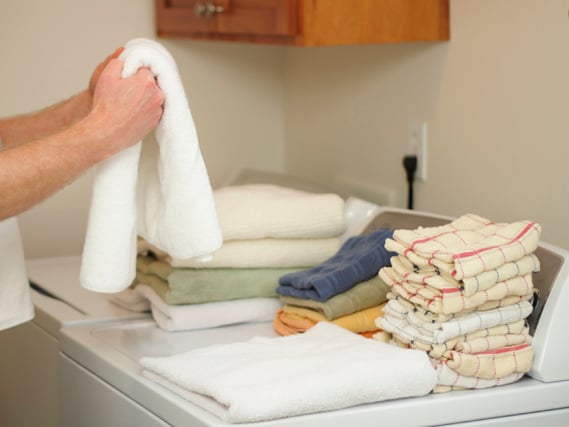
Just as parents sometimes sign their college children up for wash ‘n’ fold services that pick up laundry and return it clean and folded, there’s now numerous apps that ensure you never have to touch a dirty sock again for all of adulthood, if you wish.
FlyCleaners, which operates right now in Brooklyn and Manhattan, will have someone pick up the laundry right from your doorstep, and return it to you within less than 24 hours. (If pickups happen before 11 a.m., it’s ready by 7 a.m. the next day.) Pickup and delivery happens from 6 a.m. until midnight daily, seven days a week. The company also offers dry cleaning services. According to estimated pricing from Manhattan ZIP codes, laundry will cost about $1.25 per pound of clothing, with individual pricing on special items like pressed shirts ($2.50 each) and dress or suit cleaning ($12 each). The company also allows you to customize how you’d like your laundry finished, down to the amount of starch or if you’d like to use bleach for an extra cost.
Washio, perhaps a larger name in the industry because it operates in six major cities (Chicago, Boston, Los Angeles, Oakland, San Francisco, and Washington, D.C.), also offers “on demand” services and delivers laundered clothing within 24 hours of pickup, right from your door. Wash and fold services (mostly for t-shirts or jeans) is about $1.39 per pound, with varying prices for blouses ($4.99), dresses ($8.75), coats ($12.99) and more. Minimum orders are $20, with a surcharge of $3.99 for orders less than $35.
This is one of the cases when convenience will have to be more important than cost, as Geoffrey A. Fowler, who tested several concierge apps for the Wall Street Journal, noted. “Washio charged me $1.60 per pound of laundry plus a delivery fee; I could have done it for a little less by bringing the hamper to a wash and fold, or a lot less by doing it myself,” he wrote. Despite the price it seems to be catching on, as TechCrunch reported in February the company has raised more than $13 million in funding.
Source: Shyp

2. Shipping

For individuals and businesses alike, shipping is one of the great logistical headaches. Now, apps are starting to creep up that eliminate your trips to the post office or nearby FedEx, UPS, or DHL site. Shipster is one of them, and basically requires people to take a picture of the item they’d like to send (from a card to a desk chair, and more), and their address plus that of the destination. A ‘Shipster’ arrives at your doorstep and takes the item, packaging it and sending it on its way to anywhere around the world. The app is live in Brooklyn and Manhattan with apparent plans to expand soon, though CEO Christian Vizcaino didn’t mention where in his interview with AlleyWatch in September 2014.
Another similar app is Shyp, which operates in New York City, San Francisco, Miami, and is in beta testing in Los Angeles. Fowler, of the Journal, said that the service picked up a package and shipped it for a fee of $5, for a total cost of about $48 for the shipment. The company negotiates bulk rates with carriers like UPS and FedEx, and the total was about what Fowler would have paid if he had gone to a shipping center and packaged it himself, he said. Both services are rated highly in Apple’s App store at 4.5 stars, though Shyp has had much more user feedback (a total of almost 250 reviews compared to Shipster’s 37).
Source: Luxe

3. Valet services

Finding a decent parking spot can be a pain in any city, a problem if you’d like to maintain the freedom of having your own car. Of all the apps Fowler used over the course of a week, the GPS-powered valet service Luxe was his favorite. The company operates in San Francisco, Los Angeles, and Chicago, and has plans to expand to Seattle and Boston. The service works much like a normal valet, with a few added perks. You let the company know via its app where you’re going to be. A valet picks up your car (and will even wash it or fuel it up for you, if you’d like), and then can return it to any spot within its service area — even if it wasn’t originally where you dropped off the car.
Fowler called the company a “marvel” of logistics, as the app tracks where you’re going so the attendant meets you at your destination at exactly the right time. (Fowler added that each of the attendants are fully vetted, trained, and insured.) The service for the entire day cost Fowler just $15 plus $3 in tip money, much less than the $35 he would normally pay for parking in his own building. That’s largely because the company negotiates better rates with underused parking garages around the city, Fowler explained. The only downside to this, he said, was that the company closes by 6 p.m. on Sundays — other days it’s open until 11 p.m. or midnight.
Source: Thinkstock

4. Health

True to the plot lines of Royal Pains, the idea of concierge medicine is one that immediately evokes images of living in the Hamptons with too much money to bother waiting in an overcrowded waiting room to see a doctor. The cost alone to get personalized care from a doctor used to put the idea of concierge medicine out of reach for most people. But with the rise of some medical apps, that’s not the case as much anymore. One Medical Group has an app that allows people to make doctor’s appointments and request prescription refills at the touch of a button, while also gaining email access to your doctor. One Medical operates in San Francisco, New York City, Washington, D.C., Boston, Chicago, Los Angeles, and Phoenix, and works with most insurance providers. The San Francisco Business Times reports that the annual fee to use the service in the Bay Area is $149, and is an employee benefit offered to those working for Twitter, Airbnb, Pinterest, Adobe, and more.
Another app that is reinstating doctors’ house calls is Heal, which is operating in Los Angeles and San Francisco. The company claims it will have a well-trained doctor to your doorstep in less than an hour from placing a request on the app, with a flat $99 fee per visit. The staff vary in their specialties from pediatric medicine to cardiology — the doctor that arrived on Fowler’s doorstep during his weeklong app tests studied at Stanford. The fee truly is $99, Fowler attested, and didn’t accept his insurance. It might not be Hamptons level, but there’s still definitely a cost for the convenience.

Source: Munchery.com

5. Meal preparation

Nothing gives you a range of possible apps to use quite like the food and meal preparation industry. AmazonFresh and others deliver foodstuffs to your door, sometimes without a delivery fee if orders reach a certain value. Instacart, which operates in about 15 national locations including San
Francisco, Philadelphia, Boston, and Chicago, is gaining lots of attention not only for its to-your-door convenience, but also for the quality of foods (especially produce) shoppers select for clients. “Our service is available to anyone who can afford our $3.99 delivery fee,” Apoorva Mehta, CEO of Instacart, told the San Francisco Business Times. The service shops at a variety of stores including Costco, Safeway, and Whole Foods, they reported, and tried to match in-store product prices, though there’s sometimes a mark-up on items like gallons of milk. The company has raised $220 million at a $2 billion valuation, the publication reported in January.
But for those who want more than the raw ingredients delivered to their doorstep, there’s a growing number of apps that will deliver hot meals for your dinner. Munchery operates in San Francisco, New York, and Seattle, and offers custom dishes from on-staff chefs including peppercorn crusted steak ($11.95 per plate), vegetarian pasta with mushrooms, peppers, and fresh pesto ($8.95), and gremolata baked salmon ($11.50). The company also contributes to local food banks for every meal purchased. Delivery is free for every meal with a $39 annual charge, the Business Times reports. Munchery is one of dozens now in the meal delivery game — others also in contention are Postmates, SpoonRocket, Caviar, and Blue Apron.

These Are the Most Popular Web Browsers Today

You’ve probably tried several web browsers and have determined which one is your favorite. But have you ever wondered which are the most popular web browsers among Internet users? You might be surprised to learn that Microsoft’s infamous Internet Explorer is still the most popular option, but Google’s Chrome is gaining users quickly.
VentureBeat’s Emil Protalinski reports that April saw the naming of Microsoft Edge, the release of Chrome 42, and the first full month of Firefox 37 availability. Between March and April, Google Chrome finally passed the 25% user share milestone, according to Net Applications, which uses data captured from 160 million unique visitors to about 40,000 websites. As Computer World’s Gregg Keizer notes, user share acts as an estimate of the percentage of the world’s Internet users who ran a specific web browser during a given month.
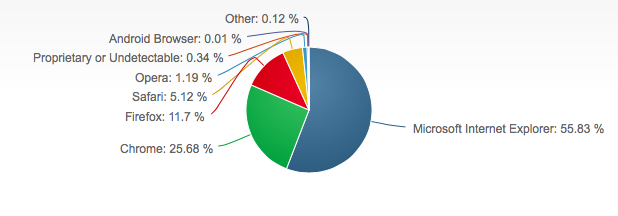
The latest figures from Net Applications show that Internet Explorer’s market share fell by 0.71 points to 55.83%, while Chrome’s market share rose 0.69 points to 25.68%. Firefox’s market share fell 0.19 points to 11.70%. Safari’s market share rose 0.12 points to 5.12%, and Opera’s market share rose 0.05 points to 0.48%.
Source: Netmarketshare.com
Protalinski reports that while Internet Explorer’s market share fell overall, there was still good news for Microsoft’s browser. The latest version of Internet Explorer, IE11, grew 0.82 percentage points while IE10 and IE9 slipped 0.17 and 0.21 percentage points, and IE8 fell 1.26 percentage points. Among even older versions of Internet Explorer, IE7 gained just 0.03 points to reach 0.37%, and IE6 fell 0.06 points to 0.92%. In October, IE11 passed IE8 to become the world’s most popular browser, and the gap between them continues to widen.
The trend toward adoption of the latest versions of Internet Explorer was catalyzed by the loss of significant market share by Windows XP, whose users can’t upgrade past IE8. (As of January 2016, Microsoft will support IE9 only on Windows Vista and Windows Server 2008, IE10 only on Windows Server 2012, and only IE11 on Windows 7, Windows 8.1, Windows Server 2008 R2, Windows Server 2012 R2, and Windows 10.) Protalinski notes that IE11 can now grow “unchallenged” until Microsoft’s new browser, Edge, arrives.
As is typical with Google Chrome, older versions of the browser continued to lose market share as Chrome 42 gained market share. Chrome 41 slipped 1.80%, Chrome 40 fell  by 5.56 percentage points, and even older versions lost market share as users adopted the newest version.
Meanwhile, Mozilla’s Firefox has continued to hit new lows for months, but its built-in upgrade system consistently sees users upgrading to newest versions of the browser. Firefox 37 gained 6.12 percentage points to hit 6.45%, while Firefox 36 dropped 5.24 percentage points and Firefox 35 fell by 1.21 percentage points.
Keizer reports that Mozilla’s Firefox reached the 25% user share milestone that Chrome just achieved in November 2009, when its user share was just over 25%. Firefox held onto that user share for a month, dipped under it, and then regained it again in March and April 2010, when it peaked at 25.1%. After that, Keizer notes, Firefox went into “more or less permanent decline.”
Mozilla’s position in the browser marketplace is growing increasingly tenuous, and in the last 10 months, Firefox has lost more than 5 percentage points. The biggest benefactor of Firefox’s losses has been Chrome, which has gained 7.8 percentage points in the past year, representing an increase of 47%.
As Business Cheat Sheet reported recently, Civic Science surveyed 1,287 adults in April to figure out what consumers’ preferences in Internet browsers say about them. Among the users that Civic Science surveyed, Google Chrome was the top web browser choice, followed by Internet Explorer, with 37% reporting that Google Chrome is their browser of choice, 29% choosing Internet Explorer, 21% picking Firefox, 10% favoring Safari, and 4% reporting that their favorite Internet browser was one other than the choices offered.
The report found that Google Chrome is the top choice of millennials who keep up with the latest trends and new products, while Internet Explorer is the browser of choice among older individuals, who have grandchildren and a high rate of home ownership.
The users who prefer Mozilla’s Firefox fall somewhere in between the characteristics of Chrome and Internet Explorer fans, and based on the smaller amounts of data gathered on those who prefer Safari, they tend to align more closely with Chrome users and skew younger and slightly more female.

Why Your Password is Hackerbait (Infographic)

Another day, another warning of potential password pitfalls. Is it just us or do the days of handwritten letters and carrier pigeons seem to be increasingly appealing?
We recently wrote about the fact that people are still using terrible passwords. The passwords themselves are just the beginning. A new infographic compiled by password-management firm Meldium shows some interesting (read: frightening) statistics on how our online behavior is leaving us vulnerable to cyberthieves.
Did you know, for instance, that 90 percent of employee passwords can be cracked in six hours? That’s less than a full work day! Moreover, nearly two-thirds of people use the same password for their many different accounts. Imagine if whomever you shared your Seamless account password with also had your online banking password. Not a pleasant thought.
The infographic below offers a look at the common ways of keeping track of various passwords, and how often people forget the magic word or phrase for a site.
Click to Enlarge
Why Your Password is Hackerbait (Infographic)

Black Friday’s Record Online Sales

The new challenge facing brick-and-mortar shops this holiday season seems to be the increasing presence of e-commerce in consumer’s daily lives. Retailers like Macy’s(NYSE:M), Target (NYSE:TGT), Wal-Mart (NYSE:WMT), and Best Buy (NYSE:BBY) made plans early this season to stave off competitors such as Amazon.com (NASDAQ:AMZN) and other e-retailers, which, unlike brick-and-mortar stores, have one distinct advantage: their doors never close.
Last year, online sales accounted for a full 40 percent of the $59 billion in sales amassed over the Black Friday weekend in 2012, and those numbers, paired with lethargic store traffic in the brick-and-mortar sphere mean that the pressure is on to lure customers into the shops. The pressures aren’t set to go away, either, with a recent Nielson survey estimating that just over 50 percent of shoppers are planning on buying something over the internet this year, a statistic up more than 10 percent from last year, compared to just 48 percent of consumers who said they were planning on visiting a “big box” store during this year’s biggest holiday shopping weekend.
As a result, Macy’s opened on Thanksgiving this year for the first time ever, and other chain retailers have begun offering Black Friday deals earlier in the day Thursday, or utilizing tactics to get customers through the door, such as keeping deals hidden until consumers set foot in store, and only unveiled at a specific time, a strategy employed by Best Buy this year. This strategy aims to prevent other retailers from matching or beating their prices, in addition to luring customers in store. Other retailers put more of their deals on the web, so as to better compete with online retail giants.
However, despite their best efforts to keep up with e-commerce Goliath Amazon.com, online sales of brick-and-mortar companies Target and Wal-Mart still only account for about 2 percent of overall sales. Both Target and Wal-Mart are planning on investing more heavily in technology over building new locations, and this year, Target made nearly all of its Black Friday discounts available online as well as in-person, a change from previous years.
On the flipside, Amazon.com has developed its own strategies for beating out its old-school competition. In the past, the company offered discounts in the days leading up to Black Friday, and this year it added new deals every 10 minutes in order to more effectively keep customers attention. With the Black Friday weekend wrapping up,Disney (NYSE:DIS) Retail’s vice president, Paul Gainer, is reporting in-line brick-and-mortar sales, but higher-than-expected online sales, a trend that seems reflected in the aforementioned investments in online technology on the part of stores like Target.
The bottom line seems to be that online retail is flourishing, and brick-and-mortar companies will need to effectively address the growing trend towards online sales if they hope to profit in the wake of e-commerce gurus like Amazon andeBay (NASDAQ:EBAY).

Are Consumers Still Hesitant About the Future?

Amid a sluggish economy and an overall weak labor market, consumer sentiment is still failing to gain momentum. According to Thomson Reuters/University of Michigan’s final reading, consumer sentiment fell to 80 in March compared to a final reading of 81.6 in February.
The results were  slightly worse than expected, as consumers feel less certain about their futures. On average, economists expected the index to reach 80.5 this month. In 2013, consumer sentiment ranged from a low of 73.2 in October to a high of 85.1 in July. The final reading for March was the worst level for consumer sentiment since November, when it reached 75.1 with the help of the government shutdown drama. The gauge has now declined for three consecutive months.
“Current conditions in the overall economy were reported by consumers to have recently weakened, and long term prospects for the economy softened,” survey director Richard Curtin said in a statement.
During the last recession, the index averaged slightly above 64. In the five years before the financial crisis, it averaged almost 90. Consumer sentiment is one of the most popular measures of how Americans rate financial conditions and attitudes about the economy. The University of Michigan’s Consumer Survey Center questions 500 households each month for the index.
Current economic conditions, which measure whether Americans think it is a good time to make large investments, decreased to 95.7 from the preliminary reading of 96.1. However, it improved from February’s reading of 95.4. Consumer expectations dropped to 70 this month from 72.7 in February.
On the positive side, the Conference Board recently reported that its Consumer Confidence Index jumped 5 percentage points to 82.3 in March compared to 78.3 in February. It was the highest reading since January 2008. Economists only expected the index to come in around 78.6. The percentage of consumers expecting business conditions to improve over the next six months increased to 18.1 percent from 17.3 percent, while those anticipating business conditions to worsen declined to 10.2 percent from 13.6 percent.

Everything You Need to Throw a Great Memorial Day Bash

With Memorial Day just around the corner, throwing a killer party is probably on your mind. While entertaining can be exciting, it’s also pretty daunting. There are a lot of components to keep track of for an outdoor gathering, and there’s nothing worse than realizing you forgot something when the big day arrives. Instead of worrying about trying to remember every detail, we’ve made your ultimate list. Stock up on these 7 must-haves and you’re sure to have the best bash in town.

 Amazon

1. Grill supplies

For most people, Memorial Day means the unofficial start of grilling season has arrived. Weber’s Rapidfire Chimney Starter lights charcoal quickly and distributes the heat evenly, so you’ll have scorching charcoal in no time. And the cone design eliminates the need for lighter fluid. Of course, you’ll want plenty of Fogo’s charcoal standing by as well. If you’re in the mood for something a little smokier, a few handfuls of soaked apple wood chips from WESTERN strewn over the top of the charcoal is a welcome addition.

2. Utensils

When it comes to outdoor cooking, standard kitchen utensils just won’t get the job done. Most of them are too short and can’t withstand such intense heat. You’ll want some grill-specific tools that will help you turn out perfect meats and veggies. Instead of trying to get everything separately, make things easier on yourself by going with a set. Cuisinart’s 14-Piece Deluxe Stainless-Steel Grill Set is equipped with everything you need, including a spatula, tongs, and even a grill brush. It all comes packed in a convenient case, so you can take your cooking gear to the park or a friend’s house.

3. Cookware

Although grill grates are a versatile cooking surface, they’re not perfect for everything. Small items like green beans or other veggies can fall right through the grates. Get all the grill flavor minus the hassle with Cuisinart’s Simply Grilling Nonstick Grilling Basket. The large surface means you can sizzle up a ton of food in no time, and the nonstick design makes for easy cleanup later. Don’t forget about kebabs, either. Wooden skewers are widely available, but we prefer the durability of these 14-inch stainless-steel ones from Norpro. They’re extra long to accommodate even the fiercest appetites. And since they’re metal, they won’t burn up over the flames.

4. Drinking glasses

Real glasses in an outdoor setting are a recipe for disaster, so save the good drinkware for indoor entertaining. Govino’s Shatterproof Stemless Wine Glasses make a smart and stylish choice. They feature a handy thumb notch, making for a solid grip. And don’t worry if one does happen to slip, because they won’t break. If you’re short on space to land those drinks, grab some Decko Outdoor Beverage Holders. No more trying to clutch a drink while eating a pile of potato salad.

5. Lighting

Just because the sun starts to set doesn’t mean the fun has to end. These LED Chinese Lanterns from Porpora do double duty as a way to illuminate the yard and add some festive decoration. And you’ll want to make sure guests can get in and out of the house to use the restroom and restock on beverages, so guide their way with Ideaworks’ Solar Powered LED Accent Lights. They’re a cinch to install, and require no maintenance since they charge during the day.

6. Entertainment

If there are any kids invited to the party, have some games on hand to keep them happy. You’ll be the hero of outdoor entertaining with the Park & Sun Spiker Sport Steel Volleyball Net. It’s an all-in-one set, complete with a full net and stakes to secure it. For those who want something a little less physical, a bean bag toss game from GoSports is a great option. The set comes with eight bean bags as well as a carrying case, making it a breeze to transport. The kids might be the first to start playing, but the adults will probably want to join in as well.

7. Seating

No one wants to end up with grass stains on their rear end, so make sure you have plenty of seating. Now is the perfect time to invest in a patio set that will last for years. This six-piece set from CASTLECREEK is an affordable option that will look great in any backyard. To accommodate the rest of the crowd, we like Coleman’s Broadband Quad Chair. The mesh back will keep your pals comfortably cool, and they come with an attached beverage holder. Plus, the fold-able design makes storage really easy.